Transformer fleets are among the most capital-intensive assets a utility operates. When a large power transformer fails unexpectedly, the consequences extend well beyond the cost of the equipment itself — unplanned outages, emergency procurement delays, regulatory scrutiny, and safety exposure can compound a single failure into a multi-million dollar event. Dissolved gas analysis remains the most widely adopted technique for detecting developing fault conditions before they reach that point. Yet in most utility organizations, the program surrounding DGA — the scheduling, sampling coordination, laboratory management, engineering review, and recordkeeping — is held together by spreadsheets, email chains, and institutional knowledge rather than a controlled operational system.
DGAWatch was built to address that gap directly.
What DGAWatch Is
DGAWatch is a utility-grade transformer diagnostics and oil sampling management platform designed to support condition-based maintenance programs across transmission and distribution fleets. It is not a standalone diagnostic calculator or a generic asset management dashboard. It is a structured operational system of record — one that covers the full lifecycle of a transformer oil sampling program, from field collection through laboratory coordination, engineering review, and long-term asset history.
The distinction matters. Utilities do not lack access to DGA interpretation tools. What they frequently lack is a controlled, traceable environment in which diagnostic data, sampling schedules, laboratory results, engineering decisions, and maintenance records are connected to one another and to the assets they describe. DGAWatch provides that environment.
The Operational Problem It Solves
A typical utility transformer program involves coordination across multiple operational groups — substation field crews, laboratory partners, regional engineering teams, and asset management functions. Each group generates data. Few organizations have a structured mechanism for connecting that data into a coherent asset record that persists over time.
The result is predictable: sampling schedules maintained in spreadsheets that fall out of sync with field activity, laboratory reports that arrive by email and are stored in shared drives without structured association to the asset, engineering reviews conducted in isolation from trend history, and maintenance decisions made without visibility into what was decided the last time the asset was reviewed.
When an asset fails, or when a regulator or insurer asks for documentation of the maintenance program surrounding it, reconstructing that history becomes a significant operational problem.
DGAWatch is structured to prevent that problem before it occurs.
Core Platform Functions
Asset and Fleet Management
DGAWatch organizes transformer fleet data using a structured hierarchy: company, location, asset, and sampling and diagnostic records. This hierarchy reflects how utilities actually operate — assets belong to substations, substations belong to regions or divisions, and all of it belongs to the organization.
The platform supports the full range of oil-filled equipment classes relevant to utility DGA programs, including power transformers, load tap changers (LTCs), oil-filled circuit breakers, regulators, reactors, and SSVTs. Each asset maintains its own complete record — equipment profile, sampling history, diagnostic results, engineering review decisions, and audit trail — in a single location.
This structure allows engineering and operations teams to work at whatever level is relevant to their function, from fleet-wide condition dashboards down to the individual asset record, without losing context or traceability at any level.
DGA Diagnostics
DGAWatch supports structured review of the full dissolved gas profile — hydrogen (H₂), methane (CH₄), ethane (C₂H₆), ethylene (C₂H₄), acetylene (C₂H₂), carbon monoxide (CO), carbon dioxide (CO₂), and TDCG — alongside oil quality parameters including moisture content, dielectric breakdown voltage, interfacial tension, acid number, and power factor.
Diagnostic workflows support severity classification, gas trend visualization, historical comparison across multiple test intervals, and engineering review with documented sign-off. The platform is designed to accommodate both system-level standards aligned with IEEE and IEC guidance and organization-specific threshold criteria, recognizing that utilities frequently operate under internal standards developed from fleet experience rather than applying published limits directly.
The emphasis throughout is on engineering review continuity. A single DGA result rarely tells the complete story of an asset's condition. Rate of change, sampling interval context, historical baseline, and trending behavior across multiple tests are often more operationally significant than any individual data point. DGAWatch is structured to make that trending context visible and persistent at the asset level.
Oil Sampling Operations
Most DGA platforms stop at the diagnostic result. DGAWatch extends upstream into the operational sampling program itself.
Utilities can generate sampling orders within the platform, assign laboratory partners, specify test types, track sample status through the full collection and laboratory cycle, and receive and validate laboratory results — all within a controlled workflow. Sampling schedules for individual assets can be driven by fixed intervals, engineering recommendations, laboratory resampling guidance, or operational risk conditions, and can be overridden with documented justification when operational circumstances require it.
The result is a traceable workflow that connects field collection activity to laboratory processing to engineering review and final disposition — with every step logged, every decision attributed, and every status change visible to the teams that need to act on it.
Engineering Review
Laboratory results uploaded to DGAWatch enter a structured engineering review workflow rather than landing in a shared folder. Engineering teams can review diagnostic results in the context of full asset history, evaluate severity classifications, compare current results against trend data, review laboratory resampling guidance, and formally approve submitted reports or request clarification from the laboratory.
Reports with clarification requests do not disappear from the record. They remain traceable within the workflow, available for revision, with the clarification request documented. Approved reports become part of the permanent asset record.
This workflow structure is designed for utility environments in which engineering accountability is not optional — where decisions about high-value assets need to be documented, attributable, and defensible over time.
Operational Visibility
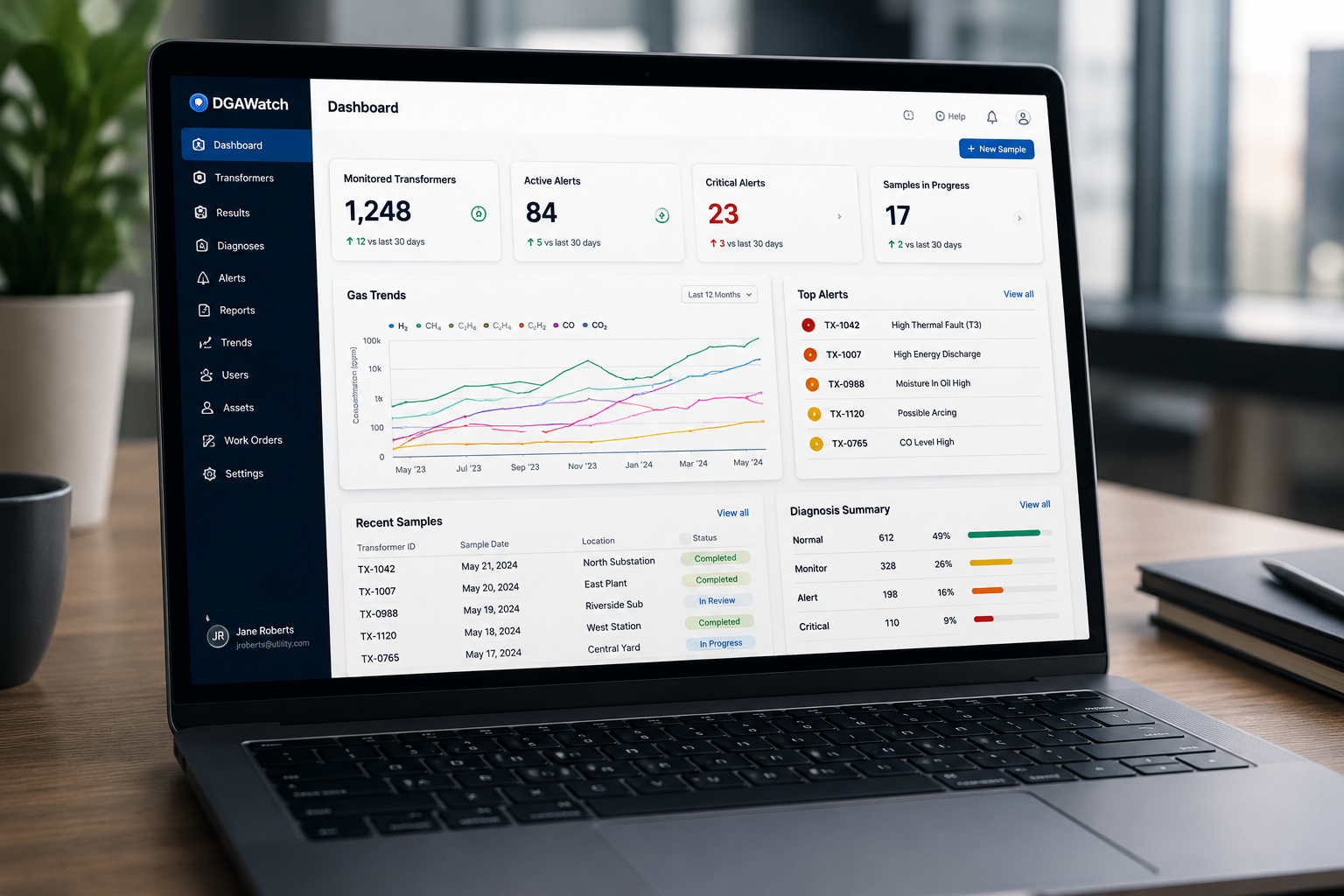
The DGAWatch dashboard provides fleet-level operational visibility across the dimensions that matter most to a transformer maintenance program: assets requiring diagnostic attention, overdue sampling, results awaiting engineering review, laboratory uploads pending, and overall severity distribution across the fleet.
This is not a reporting interface. It is an operational surface designed to support daily program management — giving engineering and operations supervisors the information they need to direct resources toward the assets and activities that require immediate attention, while maintaining visibility into the overall health of the program.
Built for Utility Operations
DGAWatch was designed specifically for utility operational environments, not adapted from a generic enterprise software model. The platform prioritizes the characteristics that utility transformer programs actually require: structured workflows, engineering review accountability, long-term traceability, and records that remain defensible across the full operational lifecycle of the assets they describe.
The objective is not to replace engineering judgment. No software platform can or should do that. The objective is to ensure that the operational program surrounding engineering judgment — the scheduling, the coordination, the data management, the review process, and the historical record — is controlled, visible, and auditable in a way that isolated spreadsheets and email-based workflows cannot support.
For utilities managing large transformer fleets under increasing pressure to demonstrate condition-based maintenance practice, that operational foundation is not a convenience. It is an operational necessity.