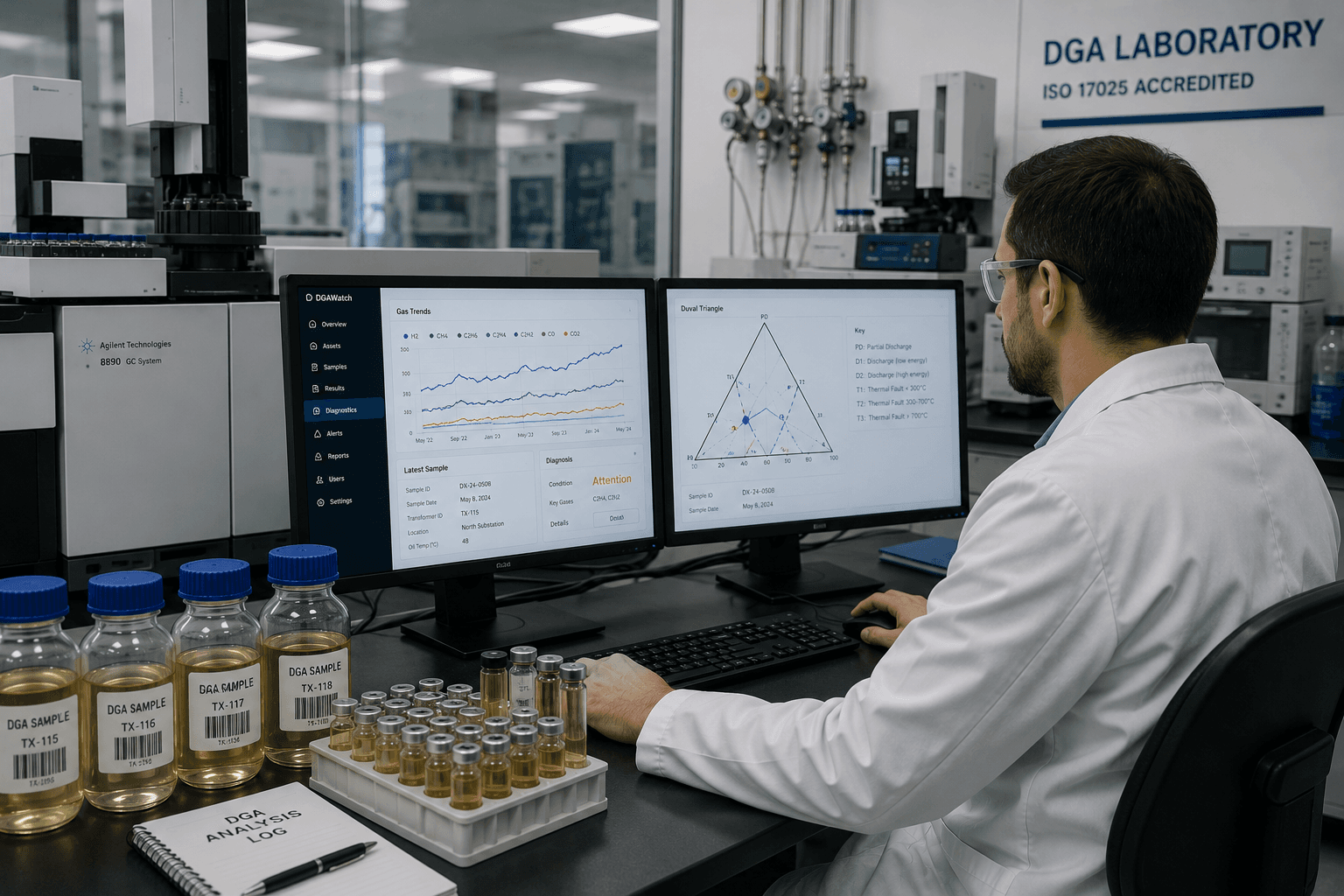
Dissolved gas analysis is not a new technique. Utilities have been extracting and analyzing gases from transformer insulating oil for decades, and the fundamental chemistry underlying the method has remained consistent throughout that time. What has changed — and continues to change — is the operational context in which DGA is applied. Transformer fleets are aging. Engineering staff with deep diagnostic experience are retiring faster than they are being replaced. Maintenance budgets are under sustained pressure while the consequences of unplanned transformer failures continue to grow in both financial and grid reliability terms.
In that environment, the ability to conduct DGA programs consistently, interpret results accurately, act on diagnostic findings in a timely and documented way, and maintain a defensible historical record of all of the above is not a technical nicety. It is an operational requirement. This article describes the diagnostic foundations of DGA, the operational challenges utilities face in applying it at scale, and how a structured platform approach addresses those challenges.
The Diagnostic Foundation
Transformer insulating oil serves dual functions: it provides electrical insulation between energized components, and it transfers heat away from the core and windings. When the oil or the solid insulation impregnated by it is subjected to thermal or electrical stress beyond normal operating conditions, decomposition occurs. That decomposition produces gases — and the identity, concentration, and relative proportions of those gases reflect the nature of the stress that produced them.
This is the diagnostic premise of DGA. By analyzing the dissolved gas content of an oil sample, an experienced engineer can draw inferences about what is happening inside the transformer without taking it out of service for internal inspection.
The gases of primary diagnostic interest are hydrogen (H₂), methane (CH₄), ethane (C₂H₆), ethylene (C₂H₄), acetylene (C₂H₂), carbon monoxide (CO), and carbon dioxide (CO₂). Each carries diagnostic significance that is worth understanding in operational terms.
Hydrogen is produced across the widest range of fault types and is often the first gas to appear in meaningful quantities as stress conditions develop. Elevated hydrogen without significant accompanying hydrocarbons may suggest partial discharge activity or corona. It is a sensitive but non-specific indicator.
Methane and ethane are associated with low-to-moderate temperature thermal conditions — oil decomposition in the range of roughly 150°C to 500°C. Their presence at elevated concentrations, particularly in conjunction with ethylene, suggests thermal fault activity in the oil.
Ethylene is a marker of higher temperature thermal faults, generally above 500°C. When ethylene is the dominant hydrocarbon and is accompanied by significant methane, a thermal fault of considerable severity should be considered. Ethylene appearing alongside acetylene raises the diagnostic concern further.
Acetylene is the gas that warrants the most immediate attention in any DGA result. It is produced under conditions of very high localized energy — electrical arcing, high-energy discharge, or extreme thermal events. Any detectable concentration of acetylene above the laboratory detection threshold demands engineering attention. IEEE C57.104 treats acetylene as a key gas indicator precisely because its presence is rarely benign at meaningful concentrations.
Carbon monoxide and carbon dioxide reflect the condition of the solid cellulose insulation — the paper and pressboard that constitute the structural insulation system of the transformer winding assembly. CO and CO₂ are natural products of paper aging, and some level of both is expected in any transformer with service history. However, elevated concentrations, a high CO₂/CO ratio suggesting active paper degradation, or rapid generation rates can indicate accelerated insulation aging, moisture ingress, or thermal stress on the solid insulation — conditions that affect the long-term serviceability of the transformer in ways that oil-phase faults alone do not.
TDCG — Total Dissolved Combustible Gas — is the sum of H₂, CH₄, C₂H₆, C₂H₄, C₂H₂, and CO. IEEE C57.104 uses TDCG as a primary condition classification index, defining four condition ranges that carry prescribed action levels. TDCG is a useful fleet-level screening tool, but it should be read in conjunction with the individual gas profile rather than in isolation. A TDCG value within the normal range that includes any detectable acetylene, for example, represents a different operational situation than the same TDCG value composed entirely of methane and ethane.
Diagnostic Interpretation in Practice
The gases described above do not exist in isolation, and their diagnostic significance is rarely determined by any single value read against a single threshold. Effective DGA interpretation involves evaluating the complete gas profile, the concentrations of individual gases relative to established thresholds and to each other, the rate at which concentrations are changing across successive samples, the sampling interval context, the asset's operating history, and the judgment of an engineer who understands what that particular transformer has experienced over its service life.
Several structured interpretation approaches have been developed to support this evaluation.
IEEE C57.104 provides condition classifications based on TDCG and individual gas thresholds, along with prescribed action levels for each condition category. It also identifies key gases — acetylene in particular — that warrant immediate attention regardless of overall TDCG. The 2019 revision updated threshold values and reinforced the importance of rate-of-change analysis alongside absolute concentration review.
IEC 60599 provides typical concentration values for gases in serviceable transformers and introduces the Duval Triangle method, which classifies fault types based on the relative proportions of methane, ethylene, and acetylene. The Duval Triangle is valuable precisely because it is ratio-based rather than threshold-based — it provides fault type classification that is less sensitive to oil volume, leak history, or prior oil processing than absolute concentration thresholds.
CIGRE technical brochures — particularly those addressing LTC diagnostics, instrument transformer assessment, and advanced DGA interpretation methods including the Duval Pentagon — extend the diagnostic framework to equipment classes and fault scenarios not fully addressed by IEEE and IEC guidance alone.
In practice, utilities frequently apply elements of multiple methodologies, supplemented by organization-specific thresholds developed from fleet experience. A large IOU operating a mixed-vintage fleet of power transformers may apply IEEE-based condition classification for routine screening, Duval Triangle analysis for fault type evaluation on elevated cases, and internal thresholds calibrated to their specific transformer population for certain equipment classes. That layered approach is not inconsistent — it reflects the operational reality that no single published standard covers every situation a utility will encounter.
The Importance of Trending
Of all the diagnostic principles relevant to utility DGA programs, the most frequently underweighted in practice is the importance of trending. A single DGA result, read in isolation against a threshold table, provides limited information. The same result read in the context of five or ten years of sampling history from the same asset provides substantially more.
The rate at which gas concentrations are changing is often more diagnostically significant than the absolute concentrations themselves. A transformer with a TDCG of 600 ppm that has been stable at that level for eight years presents a fundamentally different risk picture than one whose TDCG has risen from 200 ppm to 600 ppm over the past eighteen months. Both may fall within the same IEEE condition category. Only one of them is demonstrating active gas generation that warrants accelerated monitoring or intervention.
IEEE C57.104 acknowledges this explicitly through its guidance on rate-of-change evaluation. IEC 60599 similarly emphasizes that the significance of a gas concentration depends substantially on whether it represents a stable background level or an actively developing condition. For utilities, operationalizing this principle requires that historical data be consistently associated with the correct asset, that sampling intervals be accurately reflected in any rate-of-change calculation, and that the full trend history be readily accessible to the engineer conducting the review.
This is precisely where most spreadsheet-based diagnostic programs fail. When DGA history is distributed across multiple laboratory report files, manually transcribed into worksheets of variable quality, and lacking consistent association with sampling intervals, trend analysis becomes an exercise in data reconstruction rather than engineering evaluation.
Oil Quality Parameters
DGA results do not stand alone in a comprehensive transformer condition assessment. Oil quality parameters provide complementary information about the condition of the insulating medium itself — information that affects both the diagnostic interpretation of DGA data and the assessment of the transformer's remaining service capacity.
Moisture content is among the most operationally significant oil quality parameters. Water in transformer oil reduces dielectric breakdown strength, accelerates paper insulation aging through hydrolysis, and can produce hydrogen under certain temperature conditions — which complicates DGA interpretation. Moisture above approximately 35 ppm in service-aged oil warrants attention. The relationship between moisture content and CO/CO₂ levels provides additional context for evaluating the condition of the solid insulation.
Dielectric breakdown voltage measures the oil's ability to withstand electrical stress without failure. Values below 50 kV in service-aged oil represent a degraded insulating condition. Declining breakdown voltage in conjunction with elevated moisture or contaminant indicators suggests that oil reconditioning or replacement should be evaluated.
Interfacial tension is sensitive to oil oxidation and contamination by polar compounds, including degradation products from paper insulation. Declining IFT — values below approximately 28 mN/m — can indicate oil aging, sludging tendency, or the presence of dissolved polar contaminants.
Acid number reflects the accumulation of acidic compounds produced by oil oxidation. Elevated acid number accelerates degradation of both the oil and the solid insulation it contacts, and values approaching or exceeding 0.10 mg KOH/g warrant consideration of oil treatment or replacement.
Reading these parameters in conjunction with DGA data — rather than in separate workflows — provides a substantially more complete picture of transformer condition than either set of data provides alone.
Diagnostic Data Management at Scale
The diagnostic principles described above are well established in the engineering literature and widely understood by experienced transformer engineers. The operational challenge for utilities is not access to the methodology. It is consistent, scalable application of the methodology across large fleets, over long time periods, with engineering staff of varying experience levels and without loss of the historical context that makes trend-based interpretation meaningful.
DGAWatch addresses this through structured diagnostic data management at the asset level. Every DGA result — all seven dissolved gases, TDCG, and the full suite of oil quality parameters — is stored in association with the specific asset, the sample date, the laboratory source, the corresponding sampling order, the uploaded laboratory report, and the engineering review history. That association is not a manual step. It is an inherent property of the workflow.
Condition classification against configurable standards — whether IEEE-based, IEC-aligned, or organization-specific — is applied consistently to every result that enters the system. Gas trend visualization presents the full sampling history for each asset in a format that supports rate-of-change evaluation without requiring manual data assembly. Diagnostic results that meet attention thresholds surface automatically in engineering review queues rather than waiting for someone to remember to check them.
The platform supports the full range of diagnostic interpretation approaches in use across the utility industry, including Duval Triangle workflows, gas ratio evaluation, and key gas analysis. These tools are presented as engineering support mechanisms — inputs to the review process — rather than automated determinations that substitute for engineering judgment.
Engineering Judgment as the Irreducible Requirement
No diagnostic platform, however well designed, eliminates the need for engineering judgment in transformer condition assessment. The standards provide guidance. The data provides evidence. The trends provide context. But the decision about what to do with a specific asset — whether to accelerate sampling, schedule an inspection, recommend load reduction, or defer action pending additional data — requires an engineer who understands the asset, its operating environment, its criticality to the system, and the full picture of its service history.
DGAWatch is designed to support that judgment, not replace it. Its function is to ensure that when an engineer sits down to evaluate a DGA result, the data they need is complete, accurate, consistently organized, and presented in a format that makes the engineering question as clear as possible. The decision that follows belongs to the engineer. The platform's job is to make sure that decision is made on the best available information, and that whatever decision is reached becomes part of a permanent, auditable asset record.
That is the operational standard to which a utility-grade diagnostic platform should be held.